
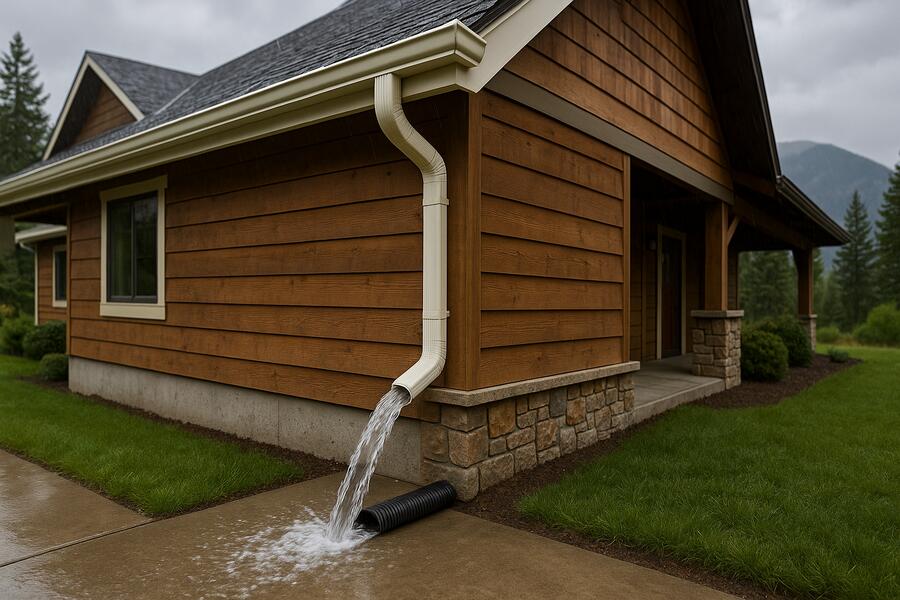
Gutters are essential for collecting rainwater and snowmelt from your roof, but they’re only half the equation for effective home drainage. The true work of diverting that water safely away from your foundation falls to the downspouts. Proper downspout placement and drainage is critical for protecting your home from water damage, especially in Missoula, MT, where we experience significant precipitation throughout the year.
Many homeowners underestimate the importance of where and how many downspouts are installed. Incorrect placement or an insufficient number can lead to serious issues, from overflowing gutters and landscape erosion to foundation damage and basement flooding. At Aces Seamless Gutters, we emphasize strategic downspout planning as an integral part of a robust gutter system. Understanding these principles is key to ensuring your home is adequately protected, and we’re experts in all things related to gutter downspouts missoula mt.
The Science of Downspout Placement and Drainage
1. Calculating the Right Number of Downspouts
There are a few rules of thumb for determining how many downspouts your home needs, taking into account both linear footage of gutters and roof drainage area.
-
Linear Footage Rule
A widely accepted guideline is to install one downspout for every 20-40 linear feet of gutter run. For climates like Missoula that can experience heavy rainfall or rapid snowmelt, it’s often better to lean towards the more aggressive end of that range, aiming for one downspout every 20-30 feet. This prevents water from traveling too far along the gutter, reducing the risk of overflow.
-
Roof Area Rule
Another crucial factor is the square footage of the roof area draining into a specific downspout. A standard 2×3-inch downspout can handle runoff from approximately 600 square feet of roof. For larger homes or those with significant roof areas, 3×4-inch downspouts (which can handle up to 1,200 sq ft) or even larger custom sizes may be necessary. Professional installers will calculate your roof’s drainage capacity and ensure adequate downspout sizing.
💡 Key Takeaway: Proper downspout count relies on both linear gutter length (one downspout per 20-40 feet, aggressive end for heavy rain/snow areas) and roof drainage area (e.g., a 2×3 downspout for ~600 sq ft). Undersizing leads to overflow and water damage.
2. Strategic Placement on the Roofline
Where downspouts are located is just as important as how many there are.
-
At the Low End of Gutter Runs
Gutters are installed with a slight slope (pitch) to ensure water flows towards the downspouts. Downspouts must always be positioned at the lowest point of a gutter section. Installing one in the middle of a long, level run will result in standing water at both ends, leading to debris accumulation and potential overflow.
-
At Building Corners
This is the most common and logical placement. Corners naturally represent the ends of many gutter runs and provide a discreet location for downspouts.
-
Near Roof Valleys
Roof valleys are areas where two roof planes meet, channeling a concentrated volume of water. These “high-flow” areas demand a downspout nearby to handle the increased water load effectively and prevent localized overflow.
-
Breaking Up Long Runs
For very long gutter runs (e.g., over 40 feet for 5-inch gutters), it’s often more effective to install a mid-run downspout in addition to those at the ends. This helps distribute the water load and ensures efficient drainage along the entire length.
💡 Key Takeaway: Downspouts should always be at the low end of gutter runs, at building corners, and strategically placed near high-flow roof valleys. For long gutter sections, adding mid-run downspouts prevents overflow and ensures efficient water diversion.
3. Directing Water Away from the Foundation
Once water is channeled into the downspout, the next critical step is ensuring it’s directed far enough away from your home’s foundation.
-
Minimum Discharge Distance
Every downspout should discharge water a minimum of 4-6 feet away from the foundation wall. Ideally, a distance of 10 feet or more is recommended to prevent soil saturation, which can lead to hydrostatic pressure against your basement walls or crawl space, causing leaks and foundation damage.
-
Extensions and Diverters
Downspout extensions (either permanent or temporary), splash blocks, or underground drainage systems are essential for achieving this critical distance. Simply allowing water to pour out at the base of the foundation is a recipe for disaster.
-
Avoid Pathways and High-Traffic Areas
Downspout outlets should be positioned to discharge water into safe runoff zones, away from doorways, patios, and walkways where it could create tripping hazards or ice patches in winter.
-
Consider Landscaping and Grading
The surrounding landscape and grading should also facilitate water movement away from the house. Even with proper downspout extensions, poor grading can cause water to pool near the foundation.
| Downspout Rule | Why It Matters | Best Practice |
|---|---|---|
| Count (Linear Ft.) | Prevents gutters from overflowing from long runs. | One downspout per 20-30 linear feet of gutter. |
| Count (Roof Area) | Ensures adequate capacity for concentrated roof runoff. | 1 downspout per 600-1200 sq ft of roof area (size dependent). |
| Placement | Ensures efficient flow and prevents standing water. | At low ends, corners, and near roof valleys. |
| Discharge Distance | Protects foundation from water saturation and damage. | Minimum 4-6 feet (ideally 10+) from foundation. |
Effective downspout placement and drainage are fundamental to a healthy home in Missoula, MT. It’s not a detail to be overlooked but a critical component of your overall home protection strategy. By understanding these principles and working with experienced professionals, you can ensure your home is well-prepared to handle any amount of precipitation.
Have questions about downspout placement and drainage? Reach out to our team today.
Frequently Asked Questions About Downspout Placement and Drainage
What is the maximum length a gutter can be without a downspout?
While some guidelines suggest a maximum of 40-50 feet for a gutter run without a downspout, this can be risky in areas with heavy rainfall or significant roof areas. A safer and more effective approach, especially for Missoula’s climate, is to aim for a downspout every 20-30 linear feet to prevent gutters from overflowing during peak water flow.
Can I add more downspouts to my existing gutter system?
Yes, in many cases, additional downspouts can be added to an existing gutter system to improve drainage performance. This is a common solution if your gutters are frequently overflowing or if you notice water pooling too close to your foundation. A professional gutter company can assess your current system and recommend optimal locations for new downspouts.
How do I ensure water is directed far enough away from my foundation?
To ensure water is directed far enough away, utilize downspout extensions (temporary or permanent) that guide water at least 4-6 feet, and ideally 10 feet, from your foundation. Alternatively, consider installing an underground drainage system that pipes water to a pop-up emitter, dry well, or daylight outlet significantly further away from your home.

