
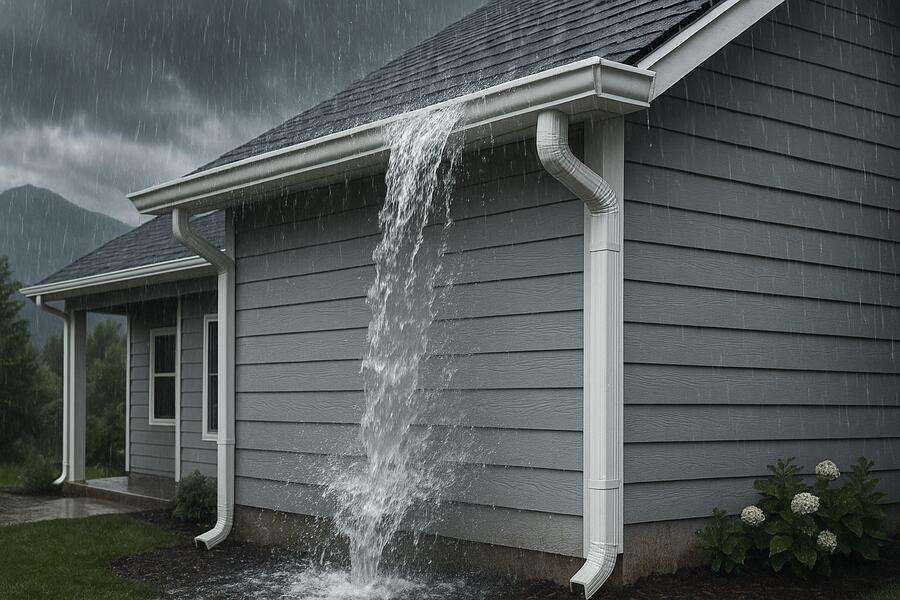
Gutters are your home’s first line of defense against water damage, channeling rainwater and snowmelt away from your roof and foundation. But a gutter system is only as effective as its downspouts. These vertical pipes are responsible for the critical task of transporting all that collected water safely to the ground and away from your home’s exterior. One of the most common questions homeowners in Missoula, MT, ask is, “How many downspouts does a home actually need?”
The answer isn’t a simple one-size-fits-all, as it depends on several factors specific to your home and local climate. Incorrectly estimating the number of downspouts can lead to overflowing gutters, water damage to your fascia, siding, landscaping, and even your foundation. This guide will break down the key considerations for determining how many downspouts your home needs to ensure efficient drainage and protection. To learn more about our services, continue reading.
Factors Influencing Downspout Count and Sizing
1. Roof Drainage Area (Square Footage)
The most critical factor in determining how many downspouts a home needs is the size of the roof section that drains into a particular gutter run. Larger roof areas collect more water, requiring more downspout capacity.
-
General Rule of Thumb:
A common guideline is to have one downspout for every 600-800 square feet of roof drainage area. This is a good starting point, but it’s often refined based on downspout size and local rainfall intensity.
-
Calculating Effective Drainage Area:
For a simple gable roof, you’d calculate the length of the house multiplied by half the roof width for each side. For more complex roofs (hips, valleys), it involves dividing the roof into sections that drain to each gutter run and factoring in the roof’s slope, as steeper roofs shed water faster.
-
Downspout Size Matters:
A standard 2×3-inch rectangular downspout can typically handle about 600 square feet of roof area (at a rainfall rate of 1 inch per hour). A larger 3×4-inch downspout can handle up to 1,200 square feet. This means that for a given roof area, using larger downspouts can potentially reduce the total number needed, but proper spacing is still critical.
💡 Key Takeaway: The square footage of your roof directly impacting a gutter section is the primary determinant of downspout count. Aim for roughly one downspout per 600-800 square feet of roof, adjusting for downspout size and local rainfall intensity.
2. Linear Footage of Gutters and Spacing
While roof area dictates overall capacity, the length of your gutter runs determines downspout placement and minimum count for effective flow.
-
Spacing Guideline:
A general rule is one downspout for every 20-40 linear feet of gutter. For areas prone to heavy rainfall or significant snowmelt, like Missoula, it’s safer to err on the lower end of that range, aiming for one downspout every 20-30 feet. Long gutter runs without enough downspouts will cause water to back up and overflow, especially at the middle.
-
Maximum Length Between Downspouts:
Most experts agree that the maximum length between downspouts should not exceed 40 feet. Beyond this, even properly sloped gutters can become overwhelmed.
-
Strategic Placement:
Downspouts should always be placed at the low end of each gutter section to ensure proper drainage. Additional downspouts are often necessary at building corners and near roof valleys, which are high-flow areas that channel a concentrated volume of water.
💡 Key Takeaway: Beyond roof area, downspout spacing is crucial. A downspout should be installed every 20-40 linear feet of gutter, with a strong recommendation for the lower end of that range in high-precipitation zones. They must be placed at the low points of gutter runs.
3. Local Rainfall Intensity
The amount of rain your area receives, and how quickly it falls, significantly impacts downspout requirements. Missoula, MT, experiences varying precipitation levels throughout the year, including heavy rainstorms and rapid snowmelt.
-
Design Rainfall Rate:
Professional gutter installers use local “design rainfall rates” (often expressed in inches per hour) to calculate the necessary gutter and downspout capacities. For instance, if your area experiences 4 inches of rain per hour, your drainage system needs to handle that volume efficiently.
-
Adjusting for Climate:
In regions with high rainfall intensity, you’ll need more downspouts or larger downspouts (or both) than in drier climates to prevent overflow during peak storms. Simply adding 50% more downspouts than the general rule is a common adjustment for heavy rainfall areas.
4. Gutter Size and Type
The size and style of your gutters also play a role in how many downspouts are needed.
-
K-Style vs. Half-Round:
K-style gutters, with their decorative front and flat back, tend to carry more water than half-round gutters of the same nominal size. Larger gutters (e.g., 6-inch vs. 5-inch) naturally have a higher capacity, which might slightly reduce the number of downspouts required for a given roof area, though proper spacing remains paramount.
| Factor | Guideline / Impact | Why it Matters |
|---|---|---|
| Roof Drainage Area | 1 downspout per 600-800 sq ft | Ensures adequate capacity for total water volume collected. |
| Gutter Linear Feet | 1 downspout per 20-40 linear feet | Prevents water backup and overflow in long gutter runs. |
| Rainfall Intensity | More downspouts/larger sizes for higher rainfall rates. | Ensures system can handle peak water flow during storms. |
| Downspout Size | Larger downspouts (e.g., 3×4″) handle more area. | Affects the capacity of each individual downspout. |
Determining the precise number and placement of downspouts for your Missoula home is a nuanced task best left to professionals. While the rules of thumb provide a good starting point, a comprehensive assessment by an experienced gutter installer will ensure your system is perfectly tailored to your home’s unique needs, protecting it efficiently for years to come.
Have questions about how many downspouts a home needs? Reach out to our team today.
Frequently Asked Questions About Downspout Count
Is it possible to have too many downspouts?
While typically less problematic than too few, having “too many” downspouts can be an unnecessary expense and might complicate landscaping or pathways around your home. However, it rarely harms drainage performance. The key is to have the right number strategically placed for optimal flow, not just an excess.
What happens if I don’t have enough downspouts?
If you don’t have enough downspouts, your gutters will likely overflow during heavy rain. This leads to water pouring over the sides, potentially damaging your fascia, siding, windows, and foundation. It can cause soil erosion, basement leaks, and compromise the structural integrity of your home over time.
Do I need a downspout at every corner of my house?
Generally, yes. Corners are natural collection points where gutter runs often meet, making them ideal and efficient locations for downspouts. They help to break up long runs and ensure that water is channeled away from multiple roof sections effectively. However, the exact configuration will depend on your roof design and gutter layout.

