
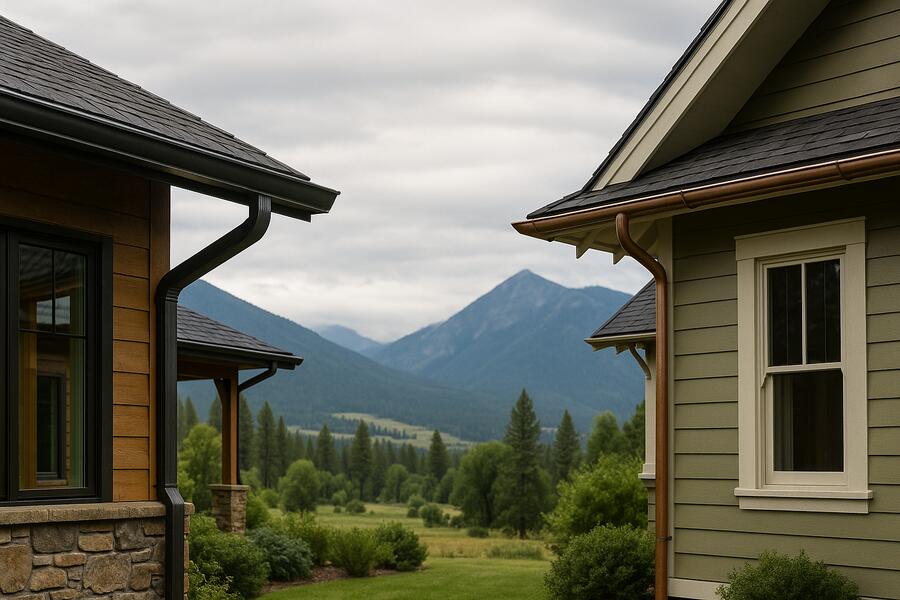
When it comes to protecting your Missoula, MT home from the elements, your gutter system plays an unsung but critical role. Beyond just funneling water, the aesthetic and functional performance of your gutters are heavily influenced by their profile style. Choosing the right gutter profile can impact everything from how much water your system can handle during a heavy downpour to how your home looks from the curb. At Aces Seamless Gutters, we understand that every home is unique, and so are its drainage needs and architectural style.
Among the various gutter profile styles available, K-style and half-round are the two most common and distinct choices for residential properties. Each offers a unique blend of benefits and drawbacks regarding water capacity, maintenance, durability, and curb appeal. Let’s delve into a detailed explanation of these popular gutter profile styles to help you make an informed decision for your home. For all your gutter needs, including seamless installation, repairs, and maintenance, trust the experts in rain gutters missoula.
K-Style Gutters: The Modern Standard
What Are K-Style Gutters?
K-style gutters are the most common gutter profile found on homes today, accounting for roughly 75-80% of new residential installations. Their distinctive profile resembles the letter “K” when viewed from the side, featuring a flat back, a decorative ogee curve or fascia-like front, and a flat bottom. This angular, often ornate appearance blends seamlessly with modern and traditional home architecture.
Key Characteristics and Benefits
-
Superior Water Capacity
One of the primary advantages of K-style gutters is their impressive water capacity. A 5-inch K-style gutter can hold approximately 1.2 to 1.5 gallons of water per linear foot, which is about 20-40% more than a similarly sized half-round gutter. This deeper, wider profile makes them highly efficient at handling heavy rainfall, crucial for preventing overflow and water damage.
-
Flat Back for Easy Installation
The flat back of K-style gutters allows them to be directly fastened to the fascia board using screws or hidden hangers, providing a secure and discreet attachment. This often results in a cleaner appearance without the need for external hangers.
-
Durability and Strength
Their angular shape provides inherent rigidity, making them quite strong and resistant to bending or warping. This robustness contributes to their long lifespan.
-
Versatile Aesthetics
K-style gutters come in various sizes (5-inch and 6-inch are most common) and materials (aluminum, copper, steel), making them adaptable to different home styles. Their decorative front edge often mimics crown molding, complementing many modern and traditional homes.
Considerations
-
Interior Cleaning:
The intricate internal corners and creases can sometimes trap debris, making manual cleaning slightly more challenging than the smoother interior of half-round gutters. However, this is largely mitigated with professional cleaning or the installation of gutter guards.
-
Dent Resistance:
While strong, the flat sections can show dents or dings more prominently than the rounded surface of half-round gutters.
💡 Key Takeaway: K-style gutters are popular for their high water capacity, robust construction, and ability to blend with diverse architectural styles. Their design efficiently handles heavy rainfall, making them a practical choice for many homes in Missoula.
Half-Round Gutters: Classic Elegance
What Are Half-Round Gutters?
As their name suggests, half-round gutters have a distinctive U-shape or semi-circular profile. They are often chosen for homes where aesthetic appeal and a classic, elegant look are prioritized, such as historic properties, Craftsman-style homes, or custom builds seeking a more refined appearance.
Key Characteristics and Benefits
-
Distinctive Curb Appeal
Half-round gutters offer a timeless, classic look that complements older or architecturally significant homes. Their smooth, curved lines provide a sophisticated aesthetic that K-style gutters can’t match.
-
Smoother Flow and Easier Cleaning
The smooth, rounded interior of half-round gutters facilitates better water flow, as there are no sharp angles for debris to catch on. Small debris is more easily flushed out, and manual cleaning, while still a chore, can be simpler due to the lack of crevices.
-
Corrosion Resistance (with specific materials)
Often made from copper or galvanized steel, half-round gutters can offer excellent corrosion resistance and develop a beautiful patina over time, adding to their classic charm.
Considerations
-
Lower Water Capacity:
For the same nominal size (e.g., 5-inch), half-round gutters typically hold less water than K-style gutters (around 0.9-1.0 gallons per linear foot). This means that for homes with large roof areas or in regions with very heavy rainfall, a larger 6-inch half-round gutter might be necessary to match the capacity of a 5-inch K-style, potentially increasing material costs.
-
Installation:
Half-round gutters require external hangers or brackets that wrap around the gutter, which are visible from the ground. While functional, some homeowners prefer the more concealed look of K-style hangers.
-
Cost:
Half-round gutters, especially in premium materials like copper, can be more expensive to purchase and install than K-style gutters, both in terms of materials and labor.
💡 Key Takeaway: Half-round gutters are chosen for their classic, elegant aesthetic and smooth interior, which helps with water flow and cleaning. They offer lower capacity than K-style gutters of the same size and typically come with a higher price tag.
Gutter Profile Styles Comparison
| Feature | K-Style Gutters | Half-Round Gutters |
|---|---|---|
| Appearance | Modern, angular, often mimics crown molding. | Classic, elegant, semi-circular shape. |
| Water Capacity (5-inch) | High (approx. 1.2-1.5 gallons/linear foot) | Moderate (approx. 0.9-1.0 gallons/linear foot) |
| Installation | Flat back mounts flush to fascia; hidden hangers. | Requires external brackets/hangers; visible. |
| Debris Resistance | Good; can accumulate in corners if not guarded. | Excellent; smooth interior helps flush debris. |
| Cost | Generally more affordable. | Typically more expensive (materials & labor). |
| Best Suited For | Most residential homes, modern or traditional. | Historic homes, architectural preservation, unique aesthetic. |
Choosing between K-style and half-round gutters ultimately comes down to balancing functional requirements with aesthetic preferences and budget. For maximum water handling and widespread compatibility, K-style is often the practical choice. However, for homes where historical accuracy or a distinct visual appeal is paramount, half-round gutters offer an undeniable charm. A professional gutter installer can help you assess your home’s unique needs and recommend the ideal gutter profile style to ensure efficient drainage and enhance your property’s curb appeal for years to come.
Have questions about gutter profile styles explained? Reach out to our team today.
Frequently Asked Questions About Gutter Profile Styles
Can I mix K-style and half-round gutters on my home?
While technically possible, mixing gutter styles on the same home is generally not recommended. It can create an inconsistent aesthetic and may complicate installation and maintenance. Most homeowners choose one style for the entire property to maintain a cohesive look and ensure optimal system performance.
Do larger gutters always mean better performance?
Larger gutters (e.g., 6-inch instead of 5-inch) certainly offer greater water capacity, which is beneficial for homes with large roof areas, steep pitches, or in regions with heavy rainfall. However, performance also depends on proper installation, adequate downspout count, and regular maintenance. An oversized gutter might be unnecessary and more expensive if not truly required for your home’s drainage needs.
Are there other gutter profile styles besides K-style and half-round?
Yes, there are other, less common gutter profiles. Some include box gutters (often built into the roof structure, common on older or commercial buildings), fascia gutters (designed to look like an extension of the fascia board), and custom-fabricated options. However, for most residential applications, K-style and half-round remain the dominant and most readily available choices.

