
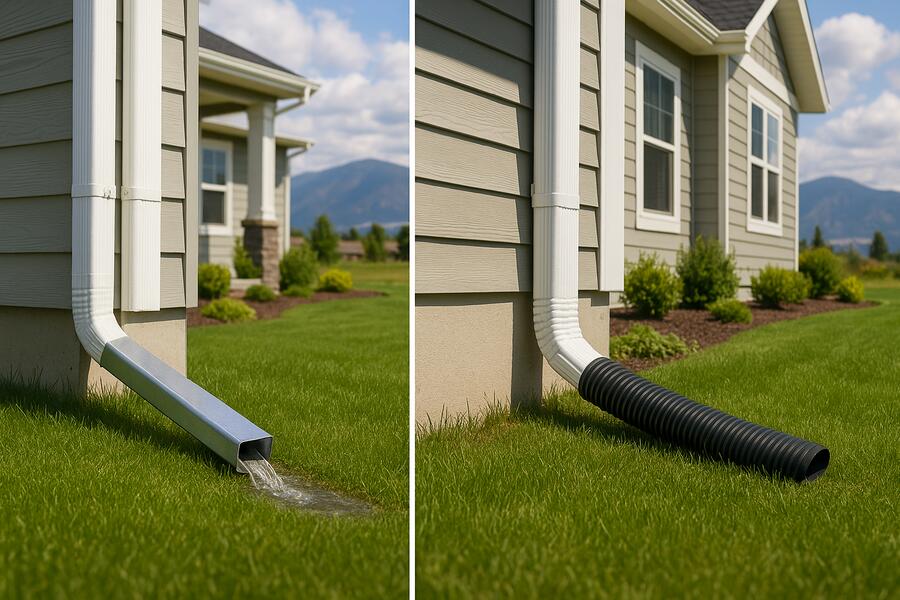
For homeowners in Missoula, MT, managing rainwater runoff effectively is crucial to protecting your home’s foundation, landscaping, and basement from water damage. Your gutter system is only as good as its downspouts, and often, the downspouts themselves need an extension to direct water sufficiently far from the house. When considering downspout extensions, you’ll generally encounter two main types: retractable and fixed. Each offers distinct advantages and disadvantages in terms of convenience, durability, and aesthetics.
At Aces Seamless Gutters, we’ve installed countless gutter systems and downspout extensions throughout Missoula, giving us firsthand experience with both styles. We understand that choosing the right extension involves balancing practical needs with personal preferences. This guide will break down the convenience and durability tradeoffs of retractable vs. fixed downspout extensions, helping you decide which is the best fit for your home and lifestyle.
Understanding Fixed Downspout Extensions
Fixed downspout extensions are the traditional choice, offering a straightforward and robust solution for water diversion.
1. Types and Materials
Fixed extensions come in various forms, designed for durability and effectiveness.
-
Rigid Extensions:
These are typically made from the same materials as your gutters and downspouts—aluminum, galvanized steel, or PVC. They maintain a consistent shape and are often secured with screws, brackets, or adhesive to ensure they stay in place. They come in fixed lengths and can be cut or joined to achieve the desired reach.
-
Hinged/Flip-Up Extensions:
A variation of rigid extensions, these include a hinge mechanism that allows you to temporarily flip the extension upwards. This is particularly useful for lawn mowing or clearing pathways, as it eliminates tripping hazards.
2. Key Advantages
-
Durability and Stability:
Fixed extensions, especially rigid ones made from metal, are highly durable. Once installed, they hold their position firmly, resisting wind, heavy rainfall, and casual impacts. They are less prone to kinking or collapsing, ensuring consistent water flow.
-
Consistent Water Diversion:
Their fixed nature means water is always directed to the same predetermined spot, which is beneficial for controlled landscaping or channeling water to a specific drainage area.
-
Aesthetic Integration:
Rigid metal extensions can be painted to match your home’s exterior, offering a clean, integrated look that doesn’t draw undue attention.
3. Key Disadvantages
-
Obstruction:
The most significant drawback is that fixed extensions can be an obstruction. They can be a mowing hazard, a tripping risk on pathways, or simply aesthetically unpleasing to have a pipe running across your yard. Even hinged versions require manual intervention.
-
Less Flexible Placement:
Their fixed nature means less adaptability if you frequently change your landscaping or need to move the water outlet point.
💡 Key Takeaway: Fixed downspout extensions, whether rigid or hinged, offer superior durability, stability, and consistent water diversion. They can also be color-matched for better aesthetics. However, their main drawback is that they can be an obstruction for lawn care or foot traffic due to their unmovable nature.
Understanding Retractable Downspout Extensions
Retractable downspout extensions offer a convenient solution for those who want to hide their extensions or prevent obstructions.
1. Types and Mechanisms
Retractable extensions are designed for automatic or manual retraction.
-
Roll-Out/Automatic Extensions:
These extensions are made from flexible vinyl or polyethylene material, often with a coiled or spring-loaded mechanism. When water flows through during rainfall, the pressure causes them to unroll and extend. Once the rain stops and the water drains, they automatically retract back into a compact cylinder near the downspout, lying flat against the house or receding into a small box.
-
Flexible/Accordion Extensions:
These are typically made from corrugated plastic and can be manually extended or retracted to various lengths. While offering flexibility, they don’t have the automatic feature of roll-out types.
2. Key Advantages
-
Convenience and Aesthetics:
Their primary benefit is convenience. Automatic versions extend only when needed and then disappear, eliminating mowing hazards, tripping risks, and keeping your yard looking neat. Manual flexible types can be easily moved or tucked away.
-
Versatility:
Flexible and roll-out extensions are excellent for navigating around garden beds, window wells, or tight spaces where a rigid pipe might be impractical.
3. Key Disadvantages
-
Durability Concerns:
Retractable extensions, especially the flexible plastic accordion types, are generally less durable than rigid fixed extensions. They can be more prone to kinking, tearing, or becoming brittle over time due to UV exposure and temperature fluctuations. The automatic mechanisms can also wear out.
-
Potential for Clogging:
The accordion-like folds or internal coils of some retractable designs can trap debris more easily, leading to clogs if not regularly maintained.
-
Less Precise Water Diversion:
While they divert water, the flexible nature might mean the water doesn’t always go to the exact same spot, especially in windy conditions, making controlled irrigation challenging.
💡 Key Takeaway: Retractable downspout extensions, particularly automatic roll-out types, offer significant convenience and aesthetic benefits by extending only during rain and then disappearing. However, they generally come with tradeoffs in durability, are more prone to clogging, and may offer less precise water diversion compared to fixed options.
Which One Is Right For Your Missoula Home?
The choice between retractable and fixed downspout extensions depends largely on your specific needs, property layout, and priorities.
-
Consider Your Landscape:
If you have open lawns frequently mowed, or pathways where an obstruction is undesirable, an automatic retractable extension offers significant convenience. If your downspout empties directly into a garden bed or a designated drainage area, a fixed extension might be perfectly suitable.
-
Durability vs. Convenience:
If maximum durability and consistent, precise water diversion are your top priorities, and you don’t mind a visible extension, fixed is often the better choice. If convenience and aesthetics outweigh slightly reduced durability, then retractable options are excellent.
-
Maintenance:
Fixed extensions are generally lower maintenance for ensuring water flow, though they can be physical obstructions. Retractable types, especially flexible ones, may require more frequent checks for clogs or damage.
| Feature | Fixed Downspout Extensions | Retractable Downspout Extensions |
|---|---|---|
| Durability | High (especially metal), resists impacts. | Lower (especially plastic), prone to kinking/tearing. |
| Convenience | Less convenient, can be an obstruction (mowing/tripping). Hinged improves. | High, automatic versions deploy/retract for clear yard. |
| Aesthetics | Visible but can be color-matched. | Less visible, retracts out of sight. |
| Clog Risk | Low, smooth interior. | Higher, internal folds/coils can trap debris. |
| Water Diversion | Precise and consistent. | Less precise, can be affected by wind/layout. |
Choosing between retractable and fixed downspout extensions for your Missoula home comes down to a careful consideration of your priorities. Both effectively move water away from your foundation, but the method and associated tradeoffs differ significantly. By weighing convenience against durability and aesthetics, you can select the solution that best fits your property’s needs and your lifestyle, ensuring optimal protection for your home.
Have questions about retractable vs fixed downspout extensions? Reach out to our team today.
Frequently Asked Questions About Downspout Extensions
How far should a downspout extension extend from the house?
Generally, a downspout extension should extend at least 4 to 6 feet away from your home’s foundation. The goal is to ensure that water is discharged well beyond the perimeter of your roofline and away from areas where it could pool against your foundation, seep into your basement, or erode landscaping. For homes on a slope, even greater distances might be necessary to direct water effectively.
Can I install downspout extensions myself?
Yes, many types of downspout extensions, particularly the flexible and some rigid plastic ones, are designed for DIY installation. They often attach with a simple slip-fit or a few sheet metal screws. However, for a more integrated, durable, and aesthetically pleasing solution, especially with rigid metal extensions or custom-fitted systems, professional installation ensures proper connection, secure fastening, and optimal water flow.
Are underground downspout extensions a good idea?
Underground downspout extensions, which channel water into buried pipes, are an excellent solution for homeowners who want to completely hide their drainage system and effectively move water significant distances away from the foundation. They are highly effective at preventing erosion and foundation issues, and they eliminate surface obstructions. While they involve a higher upfront cost and more complex installation, they offer superior aesthetics and long-term, low-maintenance drainage.

