
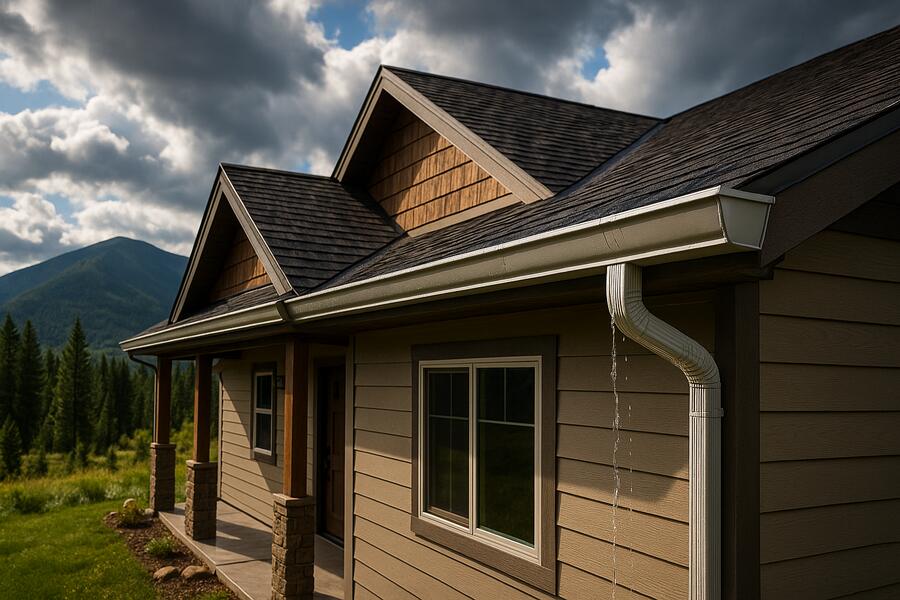
When it comes to protecting your Missoula, MT home from the harsh realities of weather – from heavy rain to significant snowfall – your gutter system plays a pivotal role. But it’s not just about having gutters; it’s about having the *right* gutters. A critical decision in this process is selecting the correct gutter profile for your roofline. The shape and style of your gutters directly impact both their aesthetic appeal and, more importantly, their functional efficiency.
Many homeowners might not realize that different gutter profiles are better suited for specific roof styles, pitches, and local climate conditions. Making the wrong choice can lead to inadequate drainage, increased maintenance, and even potential water damage to your home’s foundation or landscaping. Understanding the nuances of each gutter profile can help ensure your home is well-protected and looks its best. For expert guidance on gutter installation missoula mt, considering your unique roofline, trust our experienced team.
Understanding Gutter Profiles: K-Style vs. Half-Round
1. K-Style Gutters (Ogee Gutters)
K-style gutters are by far the most popular choice for residential homes in the United States, and for good reason.
-
Appearance:
Their distinctive profile features a flat bottom, a decorative ogee curve on the front face (resembling crown molding), and a flat back that rests flush against the fascia board. This angular, decorative look complements a wide range of architectural styles, from traditional to contemporary.
-
Capacity & Strength:
The K-style design allows them to hold more water than an equivalent-sized half-round gutter, making them highly efficient for managing heavy rainfall. The folded design also provides greater rigidity and strength, making them less prone to bending or sagging under the weight of water or snow.
-
Installation:
They are typically attached directly to the fascia board with hidden hangers, which offers a clean, seamless look.
-
Typical Use Case:
Ideal for most single-family homes with standard to moderately steep roof pitches, capable of handling significant roof drainage areas.
2. Half-Round Gutters
Half-round gutters offer a classic, elegant aesthetic, often seen on older or historically inspired homes.
-
Appearance:
As the name suggests, they have a semicircular, U-shaped trough that presents a smooth, clean line. They often come with exposed hangers that cradle the gutter, contributing to their distinctive look.
-
Capacity & Strength:
While aesthetically pleasing, half-round gutters typically have less carrying capacity than K-style gutters of the same nominal size due to their shape. They also tend to be less rigid.
-
Installation:
They require specialized brackets or hangers that support the curved trough, either attached to the fascia or directly to the roof rafters.
-
Typical Use Case:
Often chosen for historical restorations, custom homes, or properties where a traditional, softer aesthetic is desired. Best suited for roofs with moderate drainage needs, or when sized appropriately for larger roofs.
💡 Key Takeaway: K-style gutters are the modern standard, offering high capacity, strength, and a decorative profile. Half-round gutters provide a classic aesthetic but generally have less capacity and require specific installation hardware.
How Roof Style and Pitch Influence Gutter Profile Choice
1. Roof Pitch and Drainage Area
The steepness of your roof (pitch) and its total drainage area are crucial factors in determining not just the size, but also the most effective gutter profile.
-
Steeper Pitches:
Roofs with a steeper pitch shed water more quickly and with greater force, increasing the volume of water entering the gutters in a short period. K-style gutters, with their higher capacity, are often better suited to manage this rapid water flow.
-
Larger Roof Areas:
Homes with expansive roof surfaces, especially multiple gables or long runs, generate significant runoff. Again, the higher capacity of K-style gutters often makes them the pragmatic choice for effective drainage, preventing overflows.
-
Calculating Effective Drainage Area:
Professionals consider the horizontal footprint of the roof and apply a pitch factor (e.g., a 12-in-12 pitch might have a factor of 1.3) to calculate the actual “effective” drainage area, ensuring the chosen gutter size and profile can handle the true volume of water.
2. Architectural Style and Aesthetics
The overall architectural style of your home plays a significant role in selecting a gutter profile for roofline integration.
-
Modern/Traditional Homes:
K-style gutters blend seamlessly with most contemporary and traditional American home designs, offering a clean, finished look that complements a variety of siding and trim styles.
-
Historic/European-Inspired Homes:
Half-round gutters are a natural fit for homes with a distinct historic character, Victorian, or European architectural influences, where their smooth, classic lines enhance the period authenticity.
-
Minimalist Designs:
Some modern minimalist designs might opt for simpler, more concealed gutter systems, but when visible gutters are necessary, the clean lines of either profile can be adapted.
💡 Key Takeaway: Roof pitch and drainage area dictate the necessary water capacity, often favoring K-style gutters for steeper or larger roofs. Architectural style guides the aesthetic choice, with K-style suiting most modern homes and half-round complementing historic designs.
3. Material and Durability Considerations
While the profile is about shape, the material choice for that profile impacts longevity.
-
Aluminum:
Both K-style and half-round gutters are commonly made from aluminum, offering a lightweight, rust-resistant, and cost-effective solution.
-
Copper/Steel:
For enhanced durability or specific aesthetics, especially with half-round profiles, materials like copper or steel can be used, though at a higher cost.
| Gutter Profile | Appearance | Capacity & Strength | Best Suited For |
|---|---|---|---|
| K-Style | Angular, decorative (crown molding look), flat back. | High capacity, very strong and rigid. | Most residential homes, steep roofs, large drainage areas. |
| Half-Round | Semicircular, smooth, classic look. | Moderate capacity, less rigid (often requires closer support). | Historic homes, European styles, moderate drainage needs. |
Choosing the ideal gutter profile for your Missoula home’s roofline is a decision that balances both functional necessity and aesthetic preference. By considering your roof’s pitch, overall drainage requirements, and the architectural style of your home, you can select a gutter system that not only effectively protects your property but also enhances its curb appeal for years to come.
Have questions about choosing the right gutter profile for your roofline? Reach out to our team today.
Frequently Asked Questions About Gutter Profiles
Does the gutter profile affect its efficiency in Missoula’s heavy snow?
Yes, the gutter profile can significantly affect its efficiency, especially with Missoula’s heavy snow. K-style gutters generally handle snow and ice better due to their greater inherent strength and larger capacity. Their deeper profile can hold more melted snow and can be reinforced with stronger hidden hangers. Half-round gutters, while functional, may be more prone to bending or sagging under extreme ice loads if not adequately supported with very close hanger spacing and heavy-gauge material.
Can I mix different gutter profiles on my home?
While technically possible, mixing different gutter profiles on the same home is generally not recommended unless there’s a specific architectural reason or transition between distinct building sections. It can look inconsistent and may complicate installation and future repairs. Most homeowners choose a single gutter profile for their entire property to maintain a cohesive and aesthetically pleasing look.
Do downspouts need to match the gutter profile?
Downspouts generally do not need to perfectly match the *profile* of the gutter (e.g., K-style gutters don’t require K-style downspouts). However, they must be adequately sized to handle the flow from the gutter and complement its style. K-style gutters often use rectangular downspouts, while half-round gutters typically pair with round downspouts to maintain the classic aesthetic. The most important factor is ensuring the downspout capacity is sufficient for the gutter it serves.

