
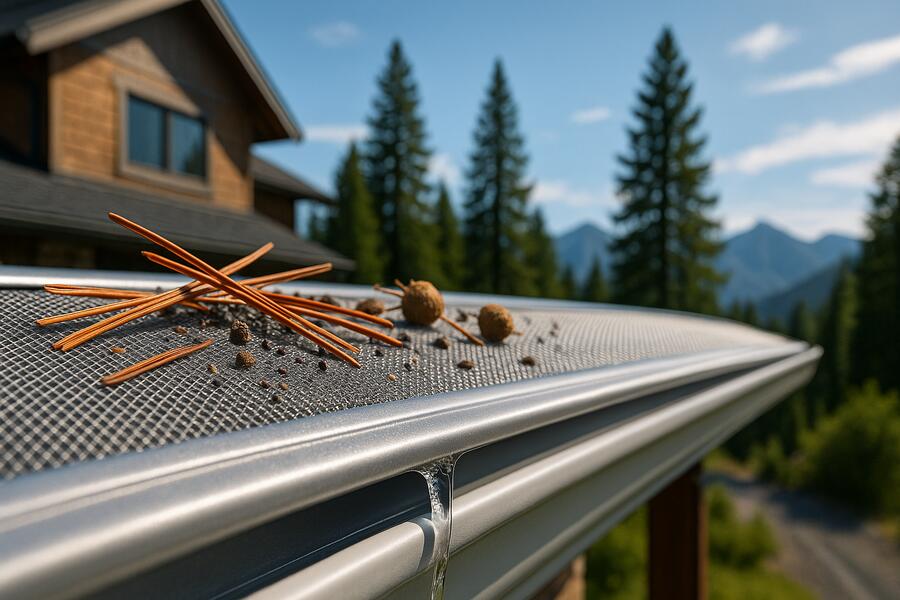
For homeowners in Missoula, MT, the beauty of living among lush trees often comes with a persistent chore: clearing gutters. While large leaves are certainly a problem, it’s often the small, insidious debris like pine needles, seed pods, and shingle grit that pose the biggest challenge. These tiny culprits can slip through many standard gutter guards, accumulating in the trough and leading to slow drainage, clogs, and even ice dams.
When searching for the best gutter guards for pine needles and other fine debris, it’s crucial to understand that not all guards are created equal. Many systems excel at blocking large leaves but fail miserably against smaller, more stubborn particles. At Aces Seamless Gutters, we frequently guide homeowners through the options, helping them select a system that truly addresses their specific debris challenges. This guide will compare different guard mesh sizes and designs, detailing how well each performs against fine debris and ultimately helping you choose the most effective solution for your home.
The Challenge of Small Debris in Gutters
Pine needles and similar small items are particularly problematic.
1. Size and Shape
Tiny but mighty in their ability to clog.
-
Needle-Like Structure:
Pine needles are thin and rigid, allowing them to easily penetrate wider mesh openings that would block larger, flat leaves. Once inside, they can interlock, forming dense mats that are difficult to dislodge.
-
Sediment and Grit:
Beyond needles, shingle grit, pollen, and small seeds also find their way into gutters. These accumulate at the bottom, creating a sludge that impedes water flow and accelerates corrosion, especially in areas with standing water.
2. Accumulation Patterns
How fine debris collects affects performance.
-
“Tea Bag” Effect:
When fine debris passes through a guard and settles in the gutter, it can create a “tea bag” effect. Water can still enter, but the debris becomes saturated, heavy, and compressed, forming a barrier that slows or stops drainage. This hidden clog can be even more insidious than a visible one.
-
Surface Tension:
Some guards, particularly those with a flat surface, can experience “sheeting” or “waterfall” effect during heavy rain. The surface tension of water allows it to bypass the mesh opening and flow directly over the guard, especially when fine debris has created a thin film on top.
💡 Key Takeaway: Small debris like pine needles, seed pods, and shingle grit are challenging because their tiny, rigid structure allows them to penetrate most standard gutter guards, forming dense, hidden clogs (the “tea bag” effect). This accumulation can lead to slow drainage, water sheeting over guards during heavy rain, and accelerated gutter corrosion.
Gutter Guard Types and Their Effectiveness Against Fine Debris
The key is aperture size and design.
1. Micro-Mesh Gutter Guards: The Top Contender
Designed for ultimate fine debris protection.
-
Ultra-Fine Filtration:
Micro-mesh guards feature a surgical-grade stainless steel mesh (typically 50 to 300 microns) that is significantly smaller than a pine needle’s diameter. This ultra-fine screen effectively blocks virtually all solid debris, including pine needles, shingle grit, pollen, and even insect nests, while allowing water to pass through.
-
Self-Cleaning Properties:
Many micro-mesh systems are designed with a slight pitch or an elevated profile that encourages debris to dry and blow off with the wind. The smooth, non-porous surface prevents pine needles from sticking or getting caught.
-
Material Quality:
Look for guards with a durable frame (e.g., aluminum) and high-quality stainless steel mesh that won’t rust or corrode. Poor quality mesh can sag or develop larger openings over time.
2. Other Guard Types: Limited Effectiveness
While useful for large leaves, they often fall short for pine needles.
-
Screen Guards (Standard/Expanded Metal):
These have larger openings (often several millimeters wide) that are too big for pine needles. Needles and seeds will easily pass through, accumulate, and cause clogs.
-
Reverse-Curve (Surface Tension) Guards:
While effective for directing large leaves over the edge, the opening where water enters can still be susceptible to pine needles or shingle grit, especially if the internal channels get clogged. Some higher-end models integrate a micro-mesh section to counter this.
-
Foam Inserts:
These porous foam wedges sit in the gutter. While they block large debris, pine needles often get stuck within the foam’s pores, trapping water and breaking down the foam over time. They are difficult to clean thoroughly.
-
Brush Inserts:
These simply fill the gutter with bristles. Pine needles and small seeds get easily caught and embedded in the bristles, making them very difficult to clean and potentially creating a breeding ground for pests.
💡 Key Takeaway: Micro-mesh gutter guards are the gold standard for pine needles, utilizing surgical-grade stainless steel mesh (50-300 microns) to block nearly all fine debris while promoting self-cleaning via wind. Other types like standard screens, reverse-curve, foam, and brush inserts are generally ineffective, as their larger openings or trapping mechanisms allow pine needles and small particles to enter, stick, or clog the system.
| Gutter Guard Type | Mesh/Aperture Size | Effectiveness for Pine Needles & Small Debris | Maintenance Required |
|---|---|---|---|
| Micro-Mesh | 50-300 microns (ultra-fine) | Excellent – blocks virtually all fine debris, allows water through. | Minimal (occasional surface brush-off) |
| Standard Screen | Several millimeters (too large) | Poor – needles easily pass through and accumulate. | Frequent cleaning of gutters underneath. |
| Reverse-Curve | Curved design, small water entry slot. | Moderate – can be bypassed by needles, internal channels prone to silt. | Occasional clearing of debris from curved surface and internal channels. |
| Foam Insert | Porous foam | Poor – traps needles within the foam, difficult to clean, degrades. | Very difficult to clean, often requires replacement. |
| Brush Insert | Bristles | Poor – needles embed themselves in bristles, hard to remove. | Frequent manual removal of embedded debris. |
When battling the relentless onslaught of pine needles and other fine debris in Missoula, choosing the right gutter guard is paramount. While many types exist, micro-mesh gutter guards stand out as the most effective solution due to their ultra-fine filtration and self-cleaning design. Investing in a high-quality micro-mesh system will provide superior protection for your gutters, dramatically reduce maintenance, and give you lasting peace of mind that your home is safeguarded against water damage.
Have questions about the best gutter guards for pine needles? Reach out to our team today.
Frequently Asked Questions About Gutter Guards and Fine Debris
Will micro-mesh gutter guards really block all pine needles?
High-quality micro-mesh gutter guards are extremely effective at blocking pine needles. Their mesh openings, typically 50 to 300 microns, are smaller than the diameter of most pine needles, preventing them from entering the gutter. While a few stubborn needles might occasionally get caught on the surface, the design often allows wind and rain to naturally clear them off, ensuring near-total blockage and excellent water flow.
Do micro-mesh gutter guards ever need cleaning?
While micro-mesh gutter guards significantly reduce maintenance, they are not entirely maintenance-free. They effectively keep debris out of the gutter trough, but very fine particles like heavy pollen, shingle grit, or sap can sometimes accumulate on the mesh surface, particularly in low-slope areas. Periodic inspection and a light brushing or rinse with a hose every year or two might be needed to maintain optimal performance, especially after heavy pollen seasons.
What happens if pine needles sit on top of the micro-mesh guard?
When pine needles land on top of a micro-mesh guard, they typically dry out and are blown away by the wind. The ultra-fine mesh prevents them from sticking or creating a “tea bag” effect inside the gutter. However, if a large quantity of needles accumulates in a very sheltered spot or is matted down by heavy rain, it might temporarily impede water flow until cleared. This is why even with micro-mesh, an occasional visual check is still a good practice.

